



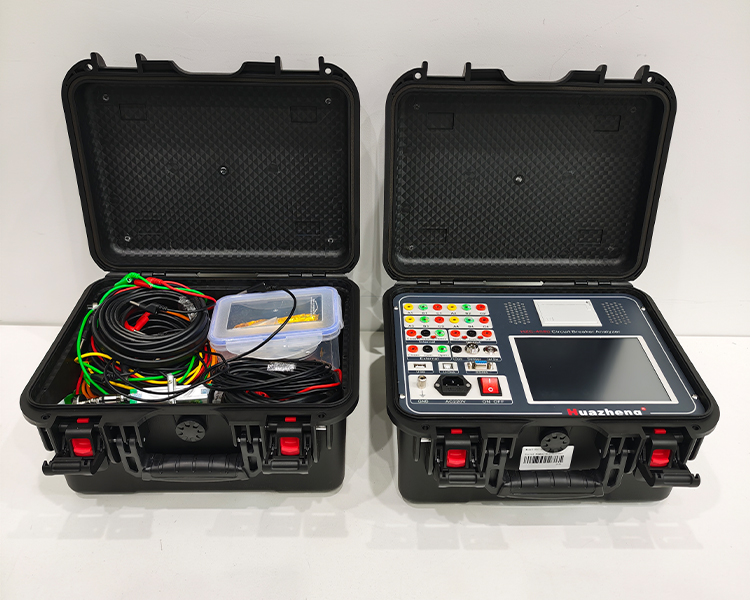
In high-voltage switch characteristic testing, speed measurement is the highest technical threshold - if the sensor is selected incorrectly and cannot be installed, it may not measure accurately, and the measured data may not meet the definition of the switch manufacturer. HZC-4080 is equipped with three types of sensors, which are suitable for different occasions. Only by understanding them clearly can the correct choice be made on site.
Universal speed sensor (accelerometer) - the simplest and most convenient
This is an innovative solution specifically developed to address the difficulty of installing traditional speed sensors. Traditional grating and photoelectric encoder sensors need to be installed on both moving and fixed parts, with high precision requirements. Different switches require different brackets to be made, making on-site installation extremely cumbersome.
The universal sensor utilizes the principle of acceleration measurement and is installed as a whole on the lifting rod, horizontal connecting rod, or other transmission rod of the circuit breaker. It does not need to be fixed on stationary components and moves together with the moving contact rod. The instrument calculates the speed and stroke based on the acceleration signal integration.
Installation points (emphasized in the manual):
The direction of the sensor socket must be consistent with the direction of movement of the transmission rod. If it is installed incorrectly, the data will be inaccurate
Clamp with a card of the corresponding radius without shaking, otherwise the measurement will be distorted
After installation, confirm that there are no obstacles within the sensor's range of motion
Rotating speed sensor - for enclosed switches
Part of the imported and joint venture switches, the linear transmission part is enclosed inside the switch body, and the installation position of the universal sensor cannot be found. This type of switch usually has installation interfaces on the on/off indicator or rotating shaft, and uses a rotation sensor.
Installation points: The axis of the rotation sensor must be concentric with the axis of the switch rotation, otherwise the rotation of the sensor will be obstructed, the measured curve burrs will be heavy, and the data will be inaccurate.
Linear travel sensor - highest accuracy
There are three specifications: 50mm (vacuum switch), 200mm, and 300mm (SF6 switch and oil switch). Accurately measuring travel and calculating speed have the highest accuracy, but on-site installation is the most complicated, requiring self-made installation brackets to ensure that the sensor rod is parallel and synchronized with the direction of motion of the moving contact.
Suitable for precision testing with strict requirements for speed accuracy, as well as occasions where high-precision data is needed for acceptance testing. Routine inspections are usually replaced by universal sensors.
The consequences of selecting the wrong sensor
If the wrong sensor type is selected in the parameter settings (such as installing a universal sensor but selecting the "straight line" option), the instrument will display full screen vertical stripes during speed testing, and the data will be completely incorrect. This is one of the common faults specifically listed in the manual. In this case, simply reset the sensor selection options.