



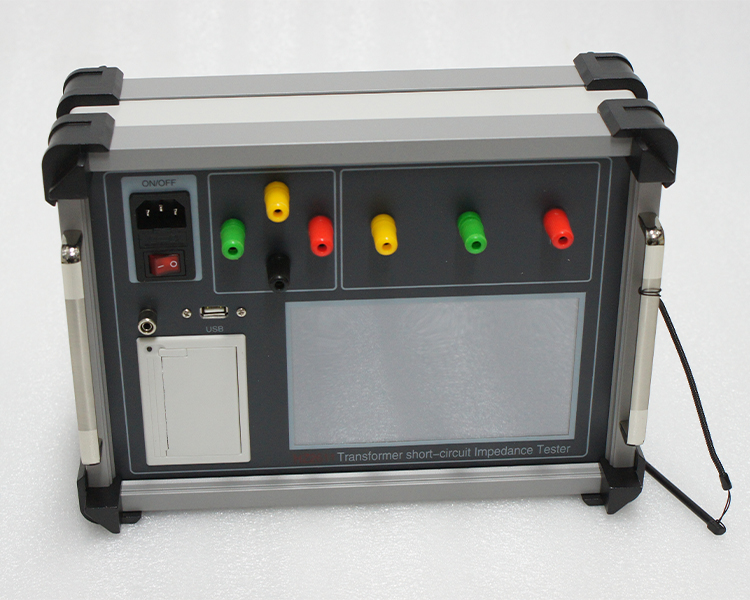
To conduct a transformer short-circuit impedance test, the secondary side needs to use a short-circuit wire to reliably short-circuit the three-phase terminals. This short circuit has its own resistance, which will be "included" in the short-circuit resistance of the transformer during the measurement process, causing the measurement results to be biased. What is the impact of short circuit resistance and how should HZ2611 be handled?
The Influence of Short Line Resistance on Measurement
Short circuits are usually made of copper wires with larger cross-sectional areas (to withstand short-circuit currents), but even with larger cross-sectional areas, there is still resistance, typically ranging from 0.1 to a few milliohms.
For small and medium-sized transformers (100kVA level), the short-circuit resistance itself may only be a few milliohms, and 0.1 milliohms of the short-circuit line accounts for about 1% to 2% of the proportion. Ignoring it directly will introduce errors of the same magnitude. For experiments that require an accuracy of 0.2%, this error is unacceptable.
Large transformers (such as 10MVA and above) have high short-circuit resistance (over ten milliohms), and the relative impact of short-circuit resistance is relatively small, which can be approximately ignored.
Short route compensation parameters for HZ2611
In the parameter setting interface, there is a "short-circuit resistance" input box used to input the wire resistance value of the secondary short-circuit connection (unit: milliohms or ohms, enter according to the interface prompt).
Operating Procedure:
Measure the resistance values at both ends of the short circuit before connecting it to the transformer using a precision multimeter or DC resistance meter
Fill in the measured value in the "short-circuit resistance" item of the parameter settings
When calculating the short-circuit resistance R, HZ2611 automatically deducts the short-circuit resistance from the measured value to obtain the true short-circuit resistance belonging to the transformer winding
If the resistance of the short circuit is extremely small or intentionally ignored by the user (such as low accuracy requirements for the results), you can input "0" and the instrument will not compensate, directly using the measured value as the result.
Practical operational suggestions
For precise measurements of small transformers (below 1000kVA), it is recommended to measure the short-circuit resistance and fill in the compensation. After the short circuit is connected, do not move or bend it (changes in contact resistance can affect the compensation effect). Confirm the reliability of the short circuit before starting the test. For large transformers, the short circuit has a large cross-sectional area and extremely low resistance, and compensation can be determined based on the actual situation.