
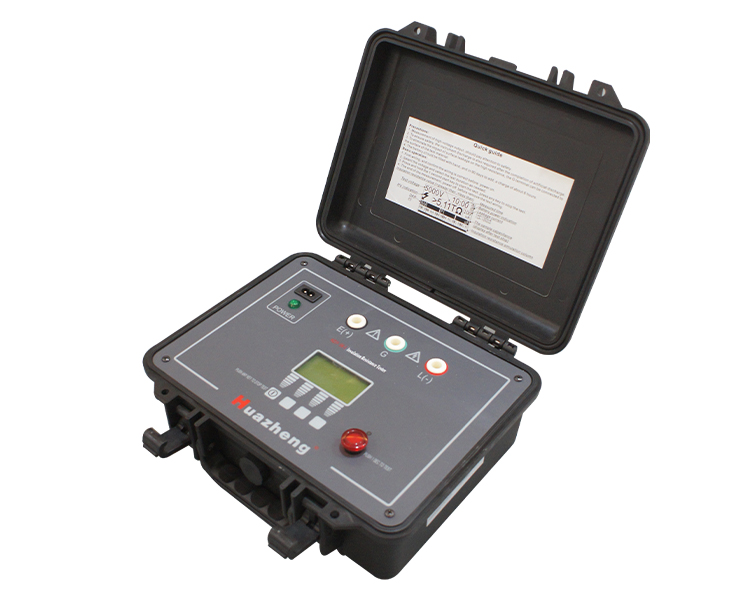
Conducting insulation resistance testing on-site at a substation is one of the most susceptible measurement scenarios to electromagnetic interference - nearby equipment can generate power frequency interference currents, which can be induced into the measurement circuit and cause drastic fluctuations in readings, making it impossible to determine the true insulation state. The four level filtering and 2mA anti-interference capability of HZJY-30KV are specially designed for this practical problem.
Sources and impacts of interference
The insulation resistance test measures extremely small leakage currents (ranging from nanoamps to microamperes). When there is electromagnetic induction interference in the location of the tested equipment (such as cables parallel to live lines or leakage magnetic fields from nearby large transformers), the current induced in the measurement circuit by these interferences may be much greater than the actual leakage current, resulting in a much lower "insulation resistance" value displayed by the instrument than the actual value, and even severe shaking that cannot be read at all.
The design goal of HZJY-30KV is to ensure testing accuracy even in harsh environments with interference currents up to 2mA. This indicator is much higher than the typical anti-interference level of several hundred microamperes for ordinary insulation resistance testers.
Selection strategy for four level filtering
HZJY-30KV provides four level filtering options to adapt to different levels of interference and measured resistance ranges:
Off (no filtering): Without any filtering, the response is the fastest, used in clean laboratory environments without interference, or in measurement situations where response speed is required.
Small (hardware low-pass filtering): Circuit level filtering that filters out high-frequency interference without significantly affecting measurement response speed, suitable for most field conditions, and is the most commonly used default choice.
Medium (software low-pass filtering): Adding software algorithm filtering on the basis of hardware filtering, the response is slightly slower but the filtering effect is stronger. The manual recommends using it when the measured insulation resistance is greater than 100G Ω - during high resistance measurement, the true leakage current is extremely small, and any residual interference will have a relatively large impact on the reading, requiring stronger filtering ability.
Large (soft+hard low-pass filtering): Hardware and software filtering work simultaneously, used for measuring ultra-high resistance with insulation resistance greater than 1T Ω. At this time, the response speed is the slowest, but it is also the only configuration that can stably output data under such extreme conditions.