


There are a wide variety of battery testing instruments on the market, ranging from simple single cell inspection devices that cost thousands of yuan to high-power charging and discharging all-in-one machines that cost tens of thousands of yuan, with different parameters. Many procurement personnel only consider "price" or "maximum power" when selecting, and often find that the voltage level is incorrect or the charging current is too small to meet the specified time limit for recharging when buying back at the site. How to accurately select the most suitable model for the actual business of our unit? These five dimensions must be firmly grasped.
Step 1: Lock the "whole group voltage level" of the tested battery pack
This is the most rigid selection red line. The nominal bus voltage of the on-site battery pack must be verified:
Select 48V gear for communication towers and data centers;
Select 110V gear for local substations and industrial and mining power grids;
Large high-voltage substations of 220kV and above must select the 220V gear;
For professional maintenance and testing units with a wide range of business scope, it is recommended to choose multi in one and cross file compatible models to prevent equipment limitations during cross site operations.
Step 2: Calculate the "charging and discharging current range" based on the rated capacity of the battery pack
According to the regulations of the power and communication industry, the standard discharge current is usually a 10 hour rate (0.1C ₁₀), and the charging current is usually taken as 0.1C ₁₀ to 0.2C ₁₀:
If the battery pack in the computer room is mainly 300Ah~500Ah, the 50A charging and discharging machine type just meets the 10 hour rate;
If there are ultra large batteries ranging from 800Ah to 1000Ah on site, the charging and discharging current must be selected in the top configuration of 100A or even 150A. Otherwise, the discharge cannot reach the standard rate, and charging will take several days and nights.
Step 3: Distinguish between the scene demands of "simple discharge instrument" and "integrated charging and discharging machine"
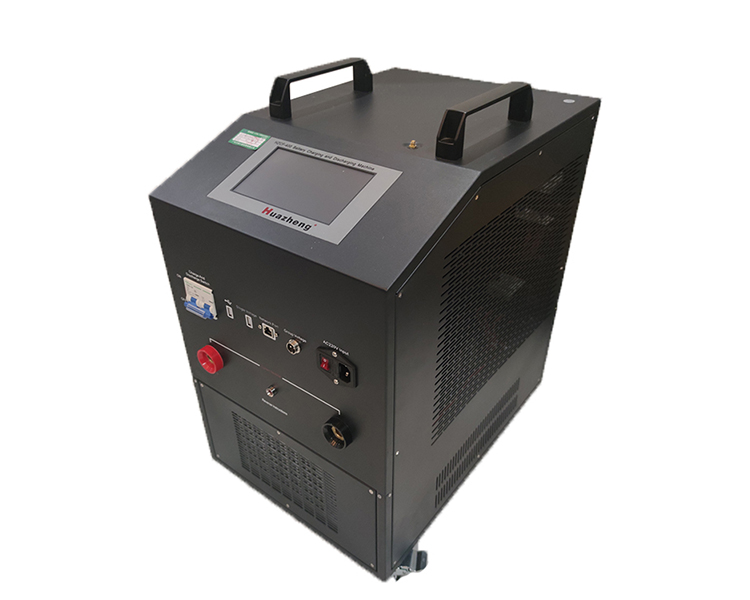
If the substation itself is equipped with a complete dual charger system, the station charger can be immediately switched to supplement power after discharge, and a single discharge meter can still handle it; But if there is only a single power supply on site, or if it belongs to communication base stations or remote unmanned station inspections, HZCF-400 integrated charging and discharging machines must be preferred. After discharge, it automatically and seamlessly recharges, completely avoiding battery depletion and idle leading to sulfurization scrap, and greatly saving on-site secondary wiring relocation work.
Step 4: Verify the specifications of individual batteries and the number of channels in the acquisition module
Confirm whether the individual battery type is 2V, 6V, or 12V, and equip sufficient acquisition modules according to the total number of batteries in each group. For example, a set of 220V lead-acid batteries typically consists of 108 cells (2V), with a single module supporting 24 cells. At least 5 individual acquisition modules (108 ÷ 24 rounded up) need to be configured on site. It is recommended to prioritize the selection of wireless transmission modules to avoid dragging long cables between hundreds of batteries.
Step 5: Pay attention to the details of intelligence and security redundancy
The safety margin of high-voltage and high current equipment cannot be ignored: confirm that the whole machine has (80-85) ℃ overheat shutdown protection and multiple electrical interlocks for input and output; Priority should be given to equipping with GSM SMS automatic alarm module and 7-inch full Chinese touch screen, complete with upper computer report management software, so that subsequent preventive testing and data archiving can truly achieve high efficiency, standardization, worry free and labor-saving.